
 EN
 DE
 RU
 FR
 PT
 ES
 IT
 JA

CVLift · Pneumatic Glass Vacuum Lifter
A compact, pneumatic glass flipping machine that turns the slowest move on the line — flipping a full sheet from flat to upright — into a one-operator, in-cell action.
On most glass lines, the bottleneck is not the saw, the furnace, or the laminating press. It is the gap between stations. A sheet leaves cutting flat, goes into tempering flat, then needs to stand up for IGU assembly, and lays back down for racking. Every one of those flat-to-upright transitions is a moment when a crew of two or three workers leans over a heavy pane, hoping nobody drops an edge or scratches the surface.
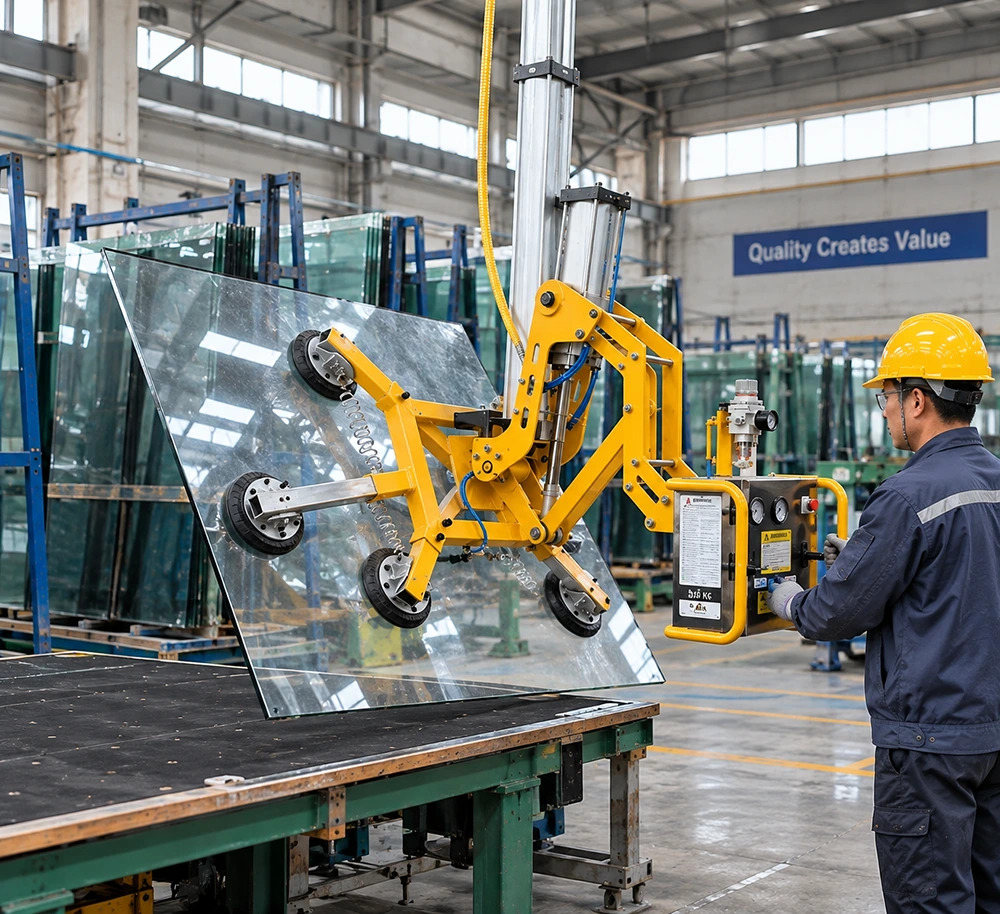
GSR CVLift is a pneumatic vacuum glass lifter built for exactly those transfer moments. Powered by shop-air instead of a battery, it stays at the cell, holds the pane with two silica-gel suction pads, and rotates it 90 degrees from horizontal to vertical — or spins it 360 degrees in plane — while the operator watches a gauge and presses a button. It does not replace the line; it removes the slowest move on the line.
Why Horizontal-to-Verticular Transfer Hurts Throughput
Glass processors talk about takt time in terms of cutting speed or furnace cycles, but the real drag sits between machines. A 6 mm tempered sheet coming off the line weighs 15 kg per square meter; a laminated IGU blank climbs well above that. Asking a two-person crew to flip such a panel from flat to upright means a lift, a wrist rotation, and a careful placement — repeated dozens of times per shift. The cost shows up as soft-tissue injuries, scratched coatings, broken corners, and a queue of half-finished panes waiting for a free pair of hands. Industry reporting on glass handling points to the horizontal-to-vertical transition as one of the most error-prone moves in the cell, because the operator is fighting gravity on a smooth, fragile surface with very little grip.

What CVLift Does at the Cell
CVLift mounts inside the work cell and runs on compressed air from the existing shop line, so it never sits waiting on a charger. The frame is yellow powder-coated steel with adjustment holes along the vertical mast, which lets the operator slide the suction crossbar up or down to match the pane size without swapping parts. Two 250 mm silica-gel pads pull vacuum through a regulator-mounted control box, and a button panel commands the 90-degree tilt from horizontal to vertical and the 360-degree in-plane rotation. A single operator can index a sheet from a cutting table, spin it to the next station's orientation, and set it down on the next conveyor or rack without ever breaking the vacuum seal. The rated working load on the catalog TR-FZ350-4 configuration is 250 kg, with a vertical lift travel of 1.2 m, sized for the medium-weight panes that move most often between stations.
How Shop-Air Power Changes the Workflow
Battery-powered glass lifters solve the mobility problem on a construction site but create a new one on the line: a charging dock, a battery-swap schedule, and a dead machine when the shift goes long. A pneumatic glass vacuum lifter wired into the plant air system runs as long as the compressor does. There is no state-of-charge to check at handover, and no mid-shift stop while a battery cools. For a fixed cell that sees the same orientation change every few minutes — flat after cutting, upright for IGU, flat again for racking — that continuity is the entire point. The trade-off is clear: CVLift is not the tool for a curtain-wall crew working off a trailer; it is the tool for a glass processing line that already has air, power, and a fixed position waiting.
Where It Fits in a Real Line
The most common cells where a glass flipping machine earns its keep are the cut-to-temper transition, the temper-to-laminate handoff, and the final inspection-to-rack station. In each, the move is the same: a horizontal pane needs to become a vertical one (or the reverse), without losing position accuracy and without dragging two operators off the next machine. CVLift's control panel sits at waist height, the suction crossbar repositions along the mast for different sheet sizes, and the silica-gel pads leave no mark on coated or low-iron surfaces. Because the unit is compact, it drops into an existing cell without forcing a re-layout of the upstream saw or the downstream rack — the bottleneck move is replaced, not the line around it.
What to Confirm Before Specifying It
Before quoting a CVLift into a cell, walk the air supply first: the shop compressor must deliver steady pressure within the pneumatic operating range the catalog calls out, and the air line must reach the cell with enough length for the operator to move around the pane. Match the rated working load (250 kg on the TR-FZ350-4 catalog page; higher-capacity configurations carry their own labels and must be confirmed against the actual build) to the heaviest pane that will run through the cell, including any future switch to thicker laminates. Decide where the suction crossbar needs to ride on the mast for the largest and smallest sheet sizes, and check that the 90-degree tilt arc has clearance from overhead cranes or light fixtures. Finally, lock in the standard safety review: vacuum gauge visibility, audible-visual low-pressure alarm, and a non-return valve so a brief air-line dip does not lose the load mid-rotation.
Buyer Checklist Before Specifying a Glass Flipping Machine
- Confirm the shop-air supply at the cell — pressure stability, hose run length, and fitting size — matches the pneumatic vacuum lifter's requirements.
- Match the rated working load (250 kg on the standard TR-FZ350-4 configuration) against the heaviest pane that will move through the cell, including future thicker laminates.
- Map the 90-degree tilt arc and the 1.2 m vertical lift travel against overhead cranes, lights, and the next machine's infeed height.
- Plan the suction crossbar position on the mast for both the smallest and largest sheet sizes the cell will see.
- Verify the control panel placement keeps the vacuum gauge, low-pressure alarm, and emergency stop within the operator's reach during a full rotation.
- Decide whether silica-gel pads (standard, non-marking) or an alternative pad material fits the coated, low-iron, or mirror surfaces on the line.
- Lock in CE / EN 13155 compliance documentation for the specific build before shipping to a European customer site.