
 EN
 DE
 RU
 FR
 PT
 ES
 IT
 JA
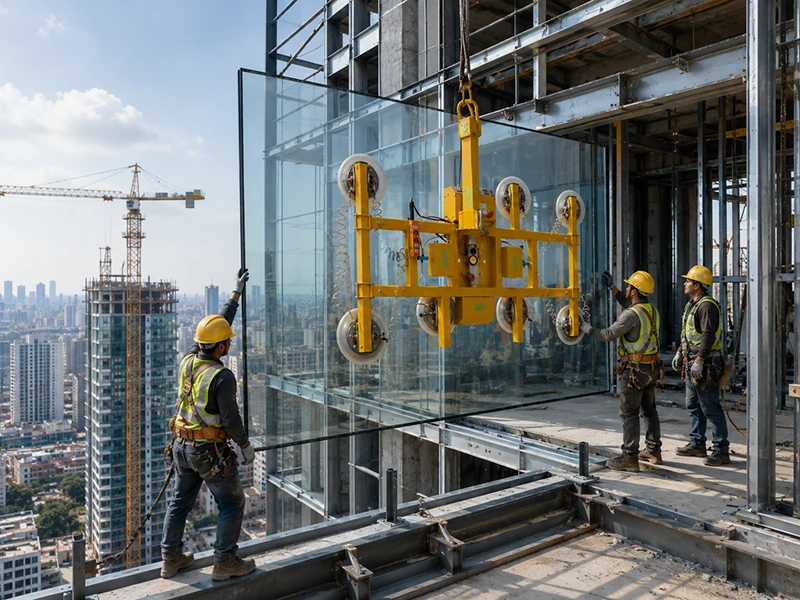
Crane suspended glass lifter
Crane suspended glass lifter is the right fit when a single laminated or fire-rated pane reaches hundreds of kilograms and handheld cups can no longer keep the load stable.
Multi-layer laminated glass, bullet-resistant glass, fire-rated ceramic interlayers, and SentryGlas laminated sheets all push the same problem to the front line: weight. A single pane can already sit in the hundreds of kilograms, and once the panel gets wider, the real difficulty is no longer only lifting force. It is how to spread the load, keep the sheet flat, and move it without edge damage or sudden slip.
That is why handheld vacuum cups and small lifting carts stop being practical. They can help with lighter sheets, but they do not solve the full transfer path from storage rack pickup to crane handling, from workshop move to final position, or from horizontal support to vertical installation. Once the glass is too heavy, too large, or too rigid to flex safely, the job needs a crane suspended glass lifter built for below-the-hook work.
Where handheld cups and small carts run out of road
The old method fails in a predictable way. Manual carrying brings too many hands too close to the edge and makes alignment slow. Handheld vacuum cups depend too much on operator strength and do not create a large enough contact footprint for oversized panes. Small carts can move a sheet across the floor, but they cannot stabilize the panel during lifting, turning, or lowering. When the load is a double 19 mm laminated sheet or a fire-rated panel stack, those limits show up immediately as re-gripping, wobble, and a higher risk of chip, crack, or drop.
The problem is even clearer in a factory line. A heavy pane may need to come off a glass storage rack, cross to a processing station, and then align above a transfer table or installation point. If the lifting tool cannot keep the sheet balanced at every step, the operator loses time and the pane loses safety margin.

Why GLClamp matches the real load path
GLClamp is built as an H-type glass vacuum lifter for exactly this kind of job. The two capacity options, 800 kg and 1200 kg, give a practical split between heavy single sheets and the even tougher transfer of large laminated or stacked panels. Instead of concentrating force at one point, the wide H-frame uses 12-24 vacuum pads and a distributed pad layout to spread the load across the panel surface.
The structure matters just as much as the number. Adjustable pad positions and single-side extension from 800 to 1500 mm let the frame match different glass footprints. The 300 mm suction cups help create a broader contact area, while the 100 kg-per-cup reference gives a clearer way to judge load distribution when the pane size grows. In other words, the lifter is not just “stronger”; it is geometrically better matched to oversized glass.
GLClamp can be crane suspended under a workshop hoist or overhead crane, and it can also move on braked universal wheels for short transfers inside the same production line. That means one unit can bridge both heavy lifting and floor transport without changing the handling logic. With battery powered operation, wired remote control, automatic pressure supply, and audio-visual alarm, the operator stays away from the load while still keeping control of the movement.
What the structure evidence shows
The product images make the load path visible. The steel frame, central control cabinet, hoses, and pressure monitoring components show that the glass is held by a distributed vacuum system rather than a single-point clamp. The 8-pad layout in the structure image demonstrates how the machine keeps a pane stable while the crane moves it through pickup, transfer, and placement. That is the difference between a tool that only lifts and a tool that supports load positioning.
On configured units, 360° rotation and 90° tilt help when a sheet needs to turn from rack orientation to installation orientation. The sealed component cover, non-return valve, and vacuum pump assembly support vacuum stability, while power-off vacuum holding helps protect the pane if power is interrupted during a move. For high-value glass, that stability is the real result the buyer is paying for.

What to confirm before you specify a crane suspended glass lifter
- Check the heaviest sheet, not the average one. If your worst-case pane or stack can reach the upper range, choose the 1200 kg configuration; if your handling is heavy but below that point, the 800 kg version may be enough.
- Match the pad layout to the panel footprint. The 12-24 pad arrangement and adjustable extension bars are there to spread load across wide laminated or fire-rated glass instead of overloading the edge.
- Decide whether the line needs overhead or floor movement. GLClamp can hang from a crane for main lifting work, then roll on braked universal wheels for short transfer inside the workshop.
- Define your safety requirements up front. Power-off vacuum holding, audio-visual alarm, pressure monitoring, and battery powered control are not extras; they are the functions that keep a heavy pane stable while it is in the air.