
 EN
 DE
 RU
 FR
 PT
 ES
 IT
 JA
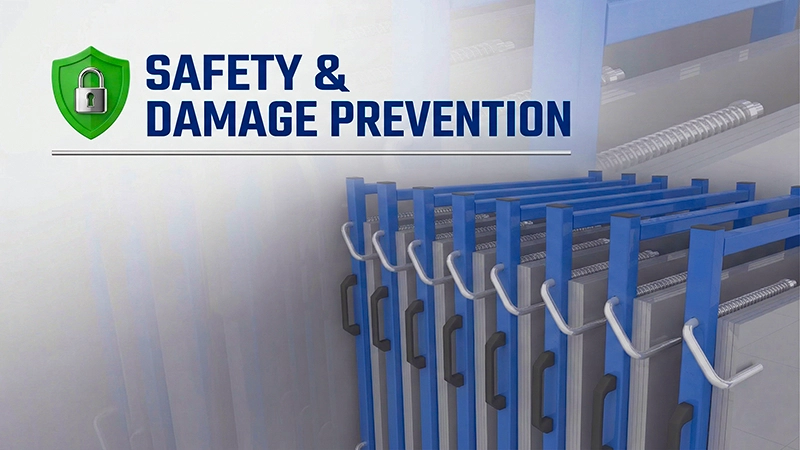
Aplarack | sheet metal rack vertical
Sheet metal rack vertical for safer heavy-sheet handling in EHS-sensitive workshops, where operators must stage, pull, and lift stacked plates without side-tip risk.
When a workshop still depends on pry bars, chain slings, or a quick manual flip to move heavy sheet stacks, the risk profile changes fast. The stack can shift before the operator clears the pinch point, and a minor alignment mistake can turn into a dropped plate, a strained back, or a failed EHS review. For teams handling metal sheet, the problem is not only storage capacity. The real problem is whether the storage method keeps people out of the load path.
Aplarack was built for that exact condition. Its sheet metal rack vertical structure keeps the sheet pack captured inside the frame, uses a 3° to 4° gravity tilt to keep the load settled back to the inner frame, and pairs that with a spring-loaded U-shaped safety stop at the front. The result is a rack that supports vertical staging and safe access without asking operators to stand in front of a falling edge.
Why manual flipping and top-heavy lifting fail first
In a mixed steel shop, the old method usually looks simple on paper: store the plates in a stack, hook them with a crane, and pull the required sheet out when needed. In practice, that workflow creates multiple hazards at once. The stack can lean, the top sheet can slide when the sling takes tension, and the operator often needs to reach too close to correct the alignment. That is where the EHS exposure starts.
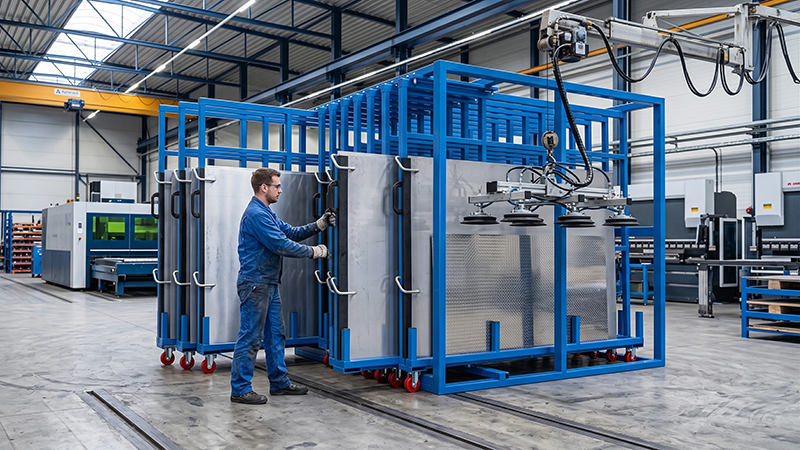
This is also why a sheet metal rack vertical layout matters. The rack changes the handling sequence from uncontrolled flipping to guided access. Operators can roll out the drawer, confirm the stack position, and keep the load supported by the frame instead of by hands, hooks, or a temporary balance point. The workshop image shows the rack in a real production setting, where the drawer extends cleanly and the load remains inside a controlled envelope.
Why Aplarack fits heavy sheet workflows
The product is not a generic storage frame. It is a handling system designed for sheet-heavy lines where the load must move in a controlled direction and stop in a controlled position. The welded Q235 steel structure gives the rack the stiffness needed for repeated drawer movement. The vertical drawer format keeps the footprint compact while preserving full access to each sheet bay.
That fit matters when the job includes heavy steel plates, irregular batch sizes, or line-side staging before cutting, grinding, or fabrication. Because the rack works with horizontal pull-out and vertical lift as separate, orthogonal actions, the operator can stay at a safer distance and let the crane or handling device do the vertical work only after the drawer has been positioned. That is a better EHS model than lifting and rotating the entire stack in one motion.
What the structure proves: tilt, lock, and safe access
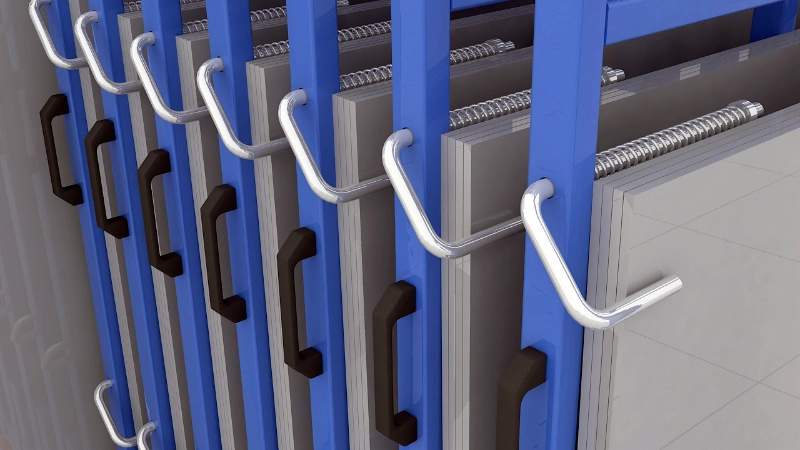
The visual proof is in the structure details. The rack uses a gravity tilt of about 3° to 4° so the sheet pack naturally settles toward the inner frame instead of leaning outward. The front safety stop is spring-loaded, so the sheet stays restrained when the drawer is moving, parked, or partly loaded. The lock pin and handle assembly shown in the detail image are there to keep the load predictable, not decorative.
Combined with the open top, the rack also supports overhead access without forcing a worker to reach over a top rail. That means a crane can engage the load from above after the drawer is in the correct position, while the operator remains outside the direct drop zone. For facilities that want to reduce incidents rather than write new work instructions around them, that mechanical separation is the real value.
What to verify before you specify a sheet metal rack vertical
- Confirm the sheet size and bundle weight so the Q235 frame, drawer geometry, and caster or track base match the real load.
- Confirm whether your workflow needs drawer-only access, overhead crane access, or both, because the rack is built for orthogonal handling, not mixed improvisation.
- Confirm the safety stop position and tilt angle so the sheet pack stays captured against the inner frame during pull-out and static storage.
- Confirm aisle width and staging direction so operators can keep clear of the load path while moving from horizontal pull to vertical lift.