
 EN
 DE
 RU
 FR
 PT
 ES
 IT
 JA
Technical Blog | Grack
Why Oldcastle BuildingEnvelope Needs a Rack That Keeps Glass Moving Without Eating the Yard
Oldcastle BuildingEnvelope does not lose time because the glass line is weak. It loses time when the next bundle is not where it should be, when an empty frame sits in the wrong lane, or when the crew needs one more hand just to clear the floor. That is the part many plants miss. The rack can become the bottleneck long before the sawline does.
Grack is built for that problem. It is a single-sided L-shape glass holding rack, not a storage prop. The standard frame in this brief measures 1800 × 950 × 1600 mm, carries 2500 kg, and keeps the empty unit down to about 80 kg. The point is not to make glass look tidy. The point is to keep production, staging, and return handling on one simple path.
The bottleneck usually shows up after the glass is already made
When a plant is busy, the schedule often looks fine on paper and messy on the floor. The crew cuts the glass, edges it, stages it, and then waits because the previous rack is still in the way. That waiting time is real. It steals attention, slows the next lift, and turns a storage frame into a process problem.
That is why OBE-style operations need a rack that works like a buffer, not a dead end. The frame has to hold the sheet upright, move with ordinary shop equipment, and come back in a compact bundle. If it cannot do all three, someone will end up rehandling the same glass twice.

What Grack changes on the floor
Grack uses a single-sided L frame, so the operator deals with one contact face and one clear handling direction. The rack can be moved by forklift or pallet jack, which matters when the plant is trying to keep the move sequence short. The frame does not ask the crew to guess which side should be loaded. It tells them where the load belongs.
The build is not light-duty. The frame uses Q235 carbon steel, full seam welding, and main members built from 50 × 50 square tube, 50 × 25 rectangular tube, and C-shaped steel at 50 × 25 × 2.0. That is what keeps the rack steady when the load is heavy and the floor team does not have time for second tries.
The loading angle matters too. The standard lean sits at 85° to 87°, with about 700 mm of usable storage width in this configuration. That gives the glass a stable backrest without forcing the crew to keep adjusting the bundle while the next station is waiting.

Why the contact face is the real protection point
Most glass damage starts at the edge. If the edge touches bare steel, the problem is not theoretical. It becomes a chip, a scratch, or a piece of glass that needs to be scrapped or reworked. Grack handles that with a steel-core rubber strip fixed by self-tapping screws. There is no glue to soften, peel, or let go in heat, humidity, or vibration.
The rubber is doing the work. The steel inside the strip stops the glass edge from cutting straight through the padding. That means the frame stays protected without turning the contact face into a weak point. In practice, it is the difference between a load that stays calm and a load that starts making metal-on-glass noise on the first rough turn.
That matters in a plant like Oldcastle’s because the rack is not sitting still. It is being staged, moved, and returned. A protection strip that stays attached is not a feature list item. It is what keeps the frame from becoming a damage source.
Empty racks should leave in stacks, not spread across the yard
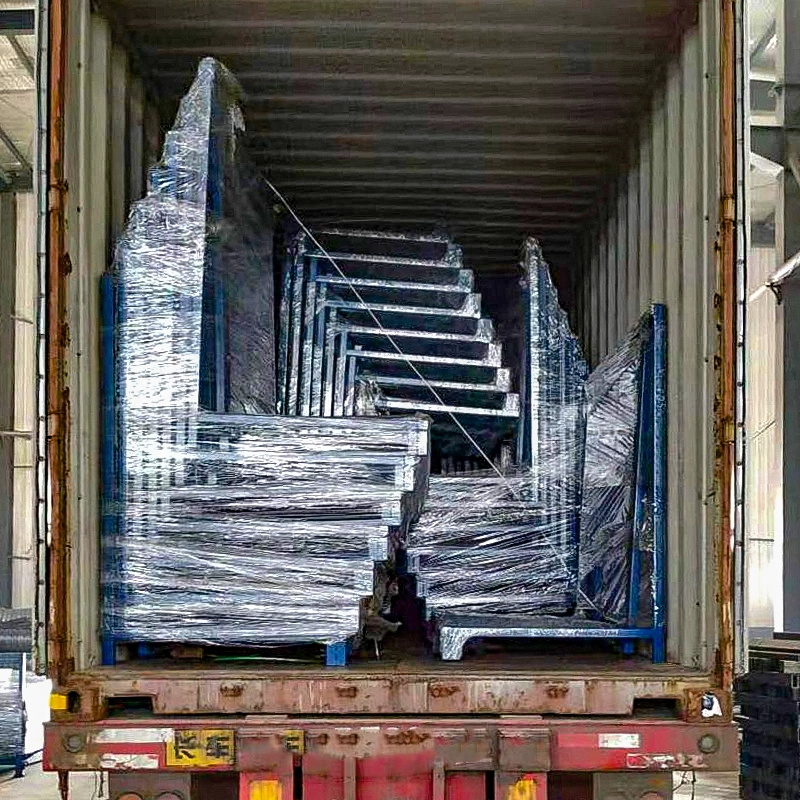
Return handling is where many rack systems waste money. If the empty frame takes up the same footprint as a loaded one, the truck goes back carrying air. Grack avoids that by nesting. Empty units can be stacked in a known pattern, with seven racks per stack in the current packing plan. That gives the yard a countable bundle instead of a loose pile.
The numbers are simple. One 20GP can take 24 units in the documented pack plan. A 40HQ can take 84 units. That is not a marketing line. It is the kind of number a logistics manager can use when deciding whether the return load belongs on one truck or two.

Container math that the yard can actually use
The best return plan is the one the team can repeat without thinking. If the empty frames are nested, wrapped, and counted in stacks, the yard does not fill up with random odd shapes that block the aisle. The crew sees seven, fourteen, or twenty-one units at a glance. That makes the next load easier to stage and keeps the dispatch lane open.
For a group like Oldcastle BuildingEnvelope, that matters because the rack is moving through a real operation, not a demo floor. The frame has to survive daily handling, but it also has to get out of the way when the work is done. Grack is designed to do both. Load it, move it, return it, stack it. Then do it again the same way tomorrow.

Project parameters
| Product | Grack L-shape glass holding rack |
| Overall size | 1800 × 950 × 1600 mm |
| Usable storage width | 700 mm |
| Rated load | 2500 kg |
| Self weight | About 80 kg |
| Main material | Q235 carbon steel |
| Main members | 50 × 50 square tube, 50 × 25 rectangular tube, C-shaped steel 50 × 25 × 2.0 |
| Contact protection | Steel-core rubber strip fixed with self-tapping screws |
| Loading angle | 85°–87° |
| Handling | Forklift and pallet jack compatible |
| Return logic | Nested or stacked empty return |
| Container plan | 24 units in 20GP, 84 units in 40HQ |
If you want a rack layout that matches your sheet sizes, fork limits, and return count, send the numbers and we will map the frame before the yard starts backing up.