
 EN
 DE
 RU
 FR
 PT
 ES
 IT
 JA
For many export buyers, the real problem with a glass transport rack does not begin when it is loaded. It begins after delivery, when an empty welded rack still takes up almost the same freight space as a loaded one. That is where Mgrack changes the economics.
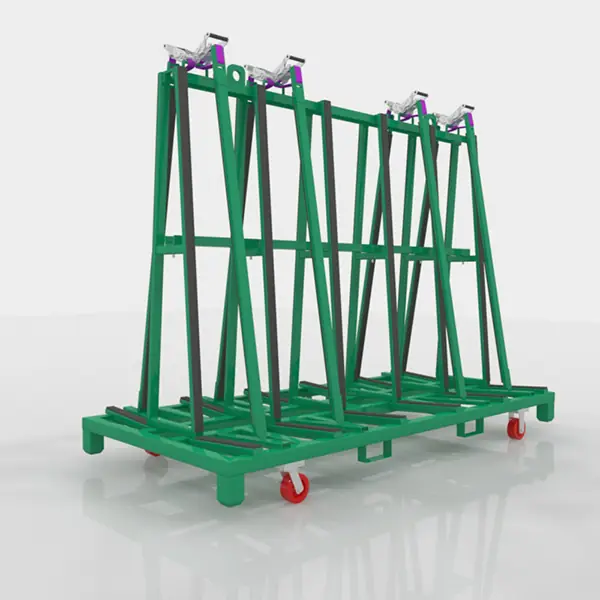
Mgrack is designed as a knock-down double-sided A-frame rack. The structure can be separated into stackable components, which means buyers are not paying to move useless empty volume over and over again. In long-distance container and truck return loops, that difference matters more than many first-time buyers expect.
Why empty return freight becomes a hidden cost
A lot of buyers compare racks by purchase price only. That sounds reasonable at first, but it ignores the cost of repeated empty transport. A welded rack that looks convenient on day one can become expensive every time it needs to be shipped back or repositioned in bulk.
Mgrack is built for buyers who understand that logistics cost is part of product cost. A rack that saves space only when loaded solves half the problem. A rack that also saves space when empty is far more useful in real circulation systems.
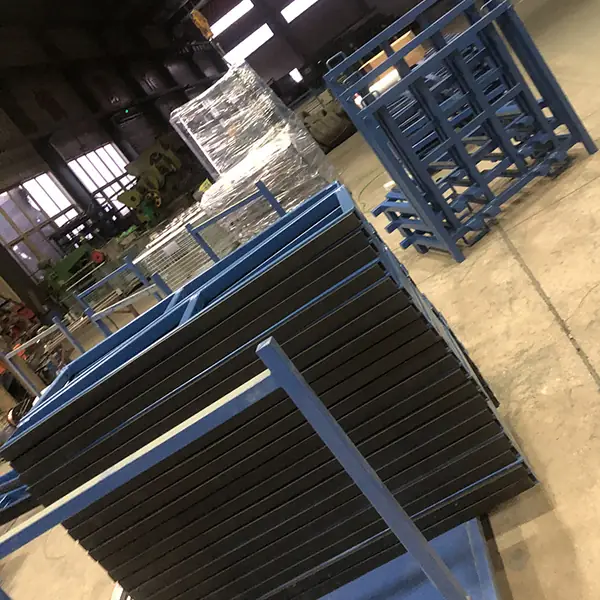
How the KD structure improves container utilization
The core advantage of Mgrack is the knock-down structure. The base and triangular support sections can be separated and stacked more densely than a fixed welded frame. That allows better use of container height and floor area during outbound shipping and empty return.
This does not mean every project gets the same loading quantity. Real loading performance depends on size, wheel configuration, and structural options. But the principle is consistent: a dismantled rack uses freight volume more efficiently than a permanently welded one.
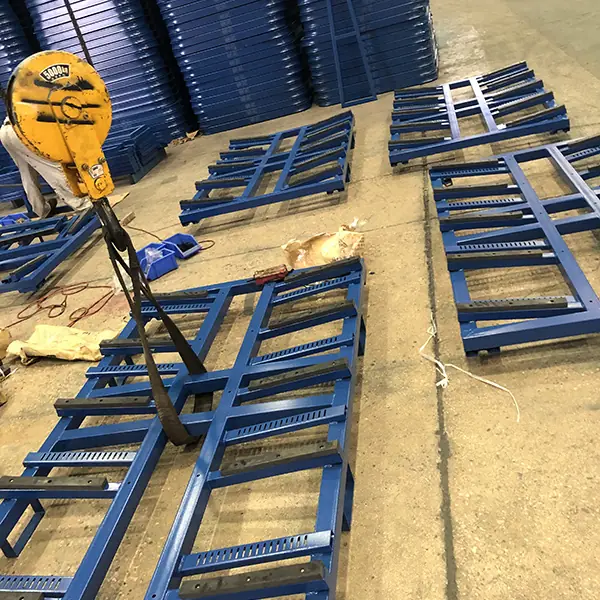
Why freight savings should be compared against labor honestly
There is no point hiding the trade-off. Mgrack is a knock-down structure, so the buyer will need bolt assembly after receipt. That means it is not the right answer for companies that want a fully welded frame with zero assembly work on site.
But for many industrial users, a short assembly step is acceptable because the freight savings are much larger over time. The right comparison is not “assembled versus unassembled.” The right comparison is total cost over repeated use.
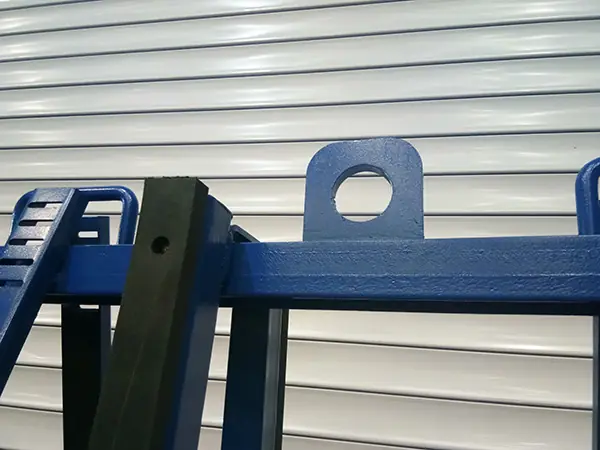
What kind of buyer benefits most from this design
Mgrack makes the most sense for companies moving glass, stone, solar panels, or similar fragile panels through repeat export or return logistics. It is especially useful where empty racks come back in batches and freight waste becomes impossible to ignore.
It is less attractive for buyers who never move the rack after installation or who treat it as a permanent static stand. In those cases, the freight advantage of the KD structure may not justify the assembly step.
Frequently Asked Questions
Q: Does every Mgrack version save the same amount of freight space?
A: No. The exact result depends on rack dimensions, wheel setup, and how the parts are packed, but the KD structure is specifically intended to improve packing density.
Q: Does Mgrack arrive fully assembled?
A: No. It is a bolt-assembled structure. Buyers need to assemble it after receipt.
Q: Can Mgrack still be used for heavy-duty panel handling?
A: Yes, but load capacity depends on the actual configuration. It should never be described as a fixed universal number without confirming structure and wheel details.
Q: What packing method is usually used?
A: Standard packing often uses film and straps to save cost, but buyers should understand that minor paint scuffing may happen in transport unless wood case packing is selected.
Ready to upgrade your workflow?
Contact our engineering team today to discuss your specific requirements and get a customized solution.