
 EN
 DE
 RU
 FR
 PT
 ES
 IT
 JA
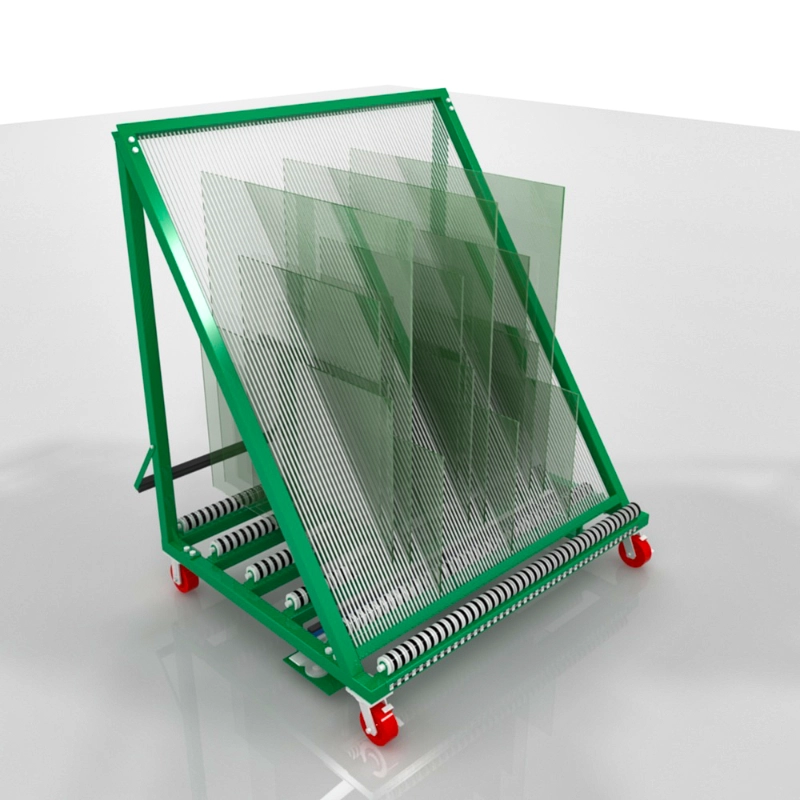
When a large architectural glass plant starts losing order sequence between cutting, tempering, pairing, and insulated glass assembly, the problem rarely begins in the ERP screen. It usually starts on the floor. A sheet is parked in the wrong slot. Another one is leaning where nobody can read it fast. Then crews spend the next hour walking, rechecking labels, and hunting for the matching lite.
That floor mess gets expensive fast in high-output plants. Rework does not always show up as breakage. It shows up as delayed furnace loading, mixed batches, waiting carts beside the IG line, and supervisors pulling people away from production just to restore order.
Dense throughput without clean vertical sorting turns simple glass movement into a hidden scheduling leak. The rack has to do more than hold sheets upright. It has to preserve order, let operators read the queue instantly, and keep each lite easy to slide in and pull out.
Floor order matters more than another forklift run
In large North American building glass operations, the real pain is not moving one sheet from point A to point B. The real pain is moving hundreds of mixed sizes through short cycle handoffs without breaking order. If the right glass is not visible at the right station, the whole line starts playing catch-up.
That is exactly where a harp rack earns its place. Instead of stacking uncertainty into one loose holding zone, it gives each sheet its own slot. The operator can see what is parked, what is next, and what is still missing. That sounds basic. On a busy floor, it is the difference between a controlled queue and daily confusion.
Loaded slot-by-slot visibility
This loaded Hrack photo shows what plants actually need: each lite parked in an independent lane, PVC-coated separators keeping contact points controlled, and a roller base that lets crews feed or pull sheets without dragging edges across steel.
Why full-base support changes the game for mixed production
Some glass programs are easy. Many are not. A large processor may be running thin glass, short pieces, tall pieces, and fast-turn insulated glass components in the same day. That is where sloppy bottom support starts causing trouble. If support is too narrow or too selective, awkward pieces become harder to stage with confidence.
Hrack data in the local product files points to practical slot management, not catalog fluff. One compact version uses 60 slots with a 14.3 mm slot width. Another project version was configured with 84 slots for 0-8 mm glass. The point is not one fixed size. The point is that the rack is built around controlled, repeatable slot staging for real production loads.
GSR Engineering Insight: A harp rack works best when the floor team can trust three things at once: the sheet will stand where it was placed, the next operator can identify it instantly, and the glass can enter or leave the slot without awkward friction. If one of those three breaks, throughput starts bleeding.
| Shop floor checkpoint | Loose staging method | Hrack approach |
|---|---|---|
| Order visibility | Mixed sheets require repeated label checks | Independent slots create readable queueing |
| Bottom entry | More dragging and edge hesitation | Nylon roller base supports smoother in-out motion |
| Thickness planning | Temporary parking gets inconsistent | Slot width can be planned around target thickness bands |
| Internal transfer control | Operators improvise holding positions | Defined channels keep each lite in its lane |
The small detail operators notice first: the roller base
Managers often start by asking about steel, wheel layout, and capacity. Operators usually notice something else first. They notice whether the glass fights them when they push it into place. Hrack uses a roller-guided base so sheets can move into the slot with less scraping and less hesitation.
That matters in high-volume plants because awkward handling adds up. If every insert and retrieval takes extra correction, the labor loss compounds across the shift. Smooth entry is not cosmetic. It is one of the things that keeps a staging rack from becoming a bottleneck.

Numbered slots cut search time
Numbered slot identifiers help crews match the right lite to the right downstream job without guesswork. In plants running repeated IG pairing or dispatch prep, this is the kind of simple control point that saves real floor time.
Knock-down structure matters when the buyer is scaling across sites
Big processors do not buy only for one corner of one building. They think about rollout, replacement, freight, and site-to-site consistency. That is why Hrack project files repeatedly point to bolt-connected, assembled structures rather than dead welded bulk. A knock-down rack is easier to ship, easier to stage in volume, and easier to standardize across branches.
One local packaging record shows a compact packed size of 141 x 114 x 20 cm at 88.2 kg. Another project note explains why buyers choose assembled-by-bolt structure when they want transport space under control without giving up daily usability. That is a practical purchasing story, not a brochure line.

Better freight logic for multi-unit orders
For plants adding dozens of racks, flat-pack logic matters. It reduces dead shipping volume and makes branch deployment easier. That is especially relevant for buyers standardizing queue racks across several production zones instead of buying one-off floor furniture.
Frequently asked questions
If your floor is losing time between stations, start with the queue
When a large processor has good machines but messy handoff zones, the next win usually does not come from buying another major asset. It comes from cleaning up the in-between. A good harp rack gives every lite a place, keeps the sequence visible, and stops operators from burning time on avoidable searching and reshuffling.
If you are mapping a new sorting area, IG buffer zone, or line-side staging plan, use the rack layout first. That is where the floor either stays honest or falls apart.