
 EN
 DE
 RU
 FR
 PT
 ES
 IT
 JA
Many Mgrack buyers do not start by asking about steel grade. They start with a practical workshop problem: too many fragile panels, not enough efficient floor movement, and too much wasted freight when empty racks go back as bulky welded frames. That is why the real value of Mgrack is not only storage. It is the combination of safe handling, reusable movement, and better export packing logic.
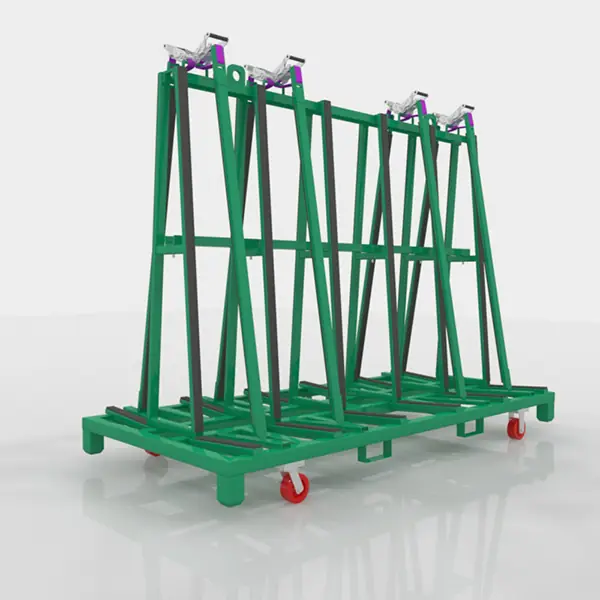
For factories handling glass, stone slabs, solar panels, or door and window components, a double-sided mobile A-frame rack can solve more than one problem at the same time. It helps create upright protected storage, improves internal transfer efficiency, and reduces the shipping penalty of empty return volume through a knock-down structure.
Why Mgrack customers focus on workshop efficiency first
In many plants, the first pain point is not loading a container. It is moving fragile panels safely from one process area to another without relying on oversized bulk handling every time. When workers need a smaller-batch transfer method that still keeps panels stable, a mobile double-sided rack becomes much more useful than a fixed stand or a temporary wooden support.
Mgrack is widely used in exactly this type of environment. Customers value the ability to push, position, restrain, and temporarily store sheet materials while keeping the workflow flexible. That is especially important where workshop space is limited and fragile material cannot simply be laid flat on the floor.
How the knock-down structure changes the freight calculation
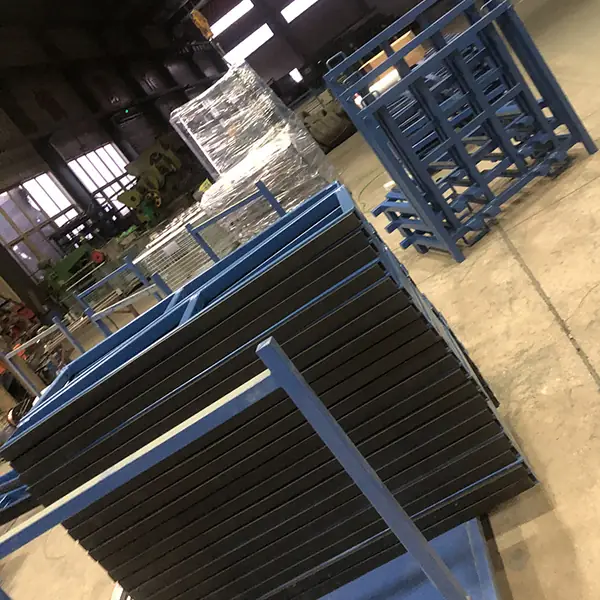
Another major concern for Mgrack customers is logistics cost. A welded rack may work well in use, but once it travels empty, too much freight space is wasted on air. That is where the knock-down structure matters. By separating the base and triangular supports, the rack can be packed more efficiently for export and empty return.
This design is one of the strongest reasons customers choose Mgrack over a fixed welded alternative. In repeat-shipment or overseas projects, better empty packing density can improve container economics in a way that directly affects purchasing decisions.

Why product protection is more than just adding rubber
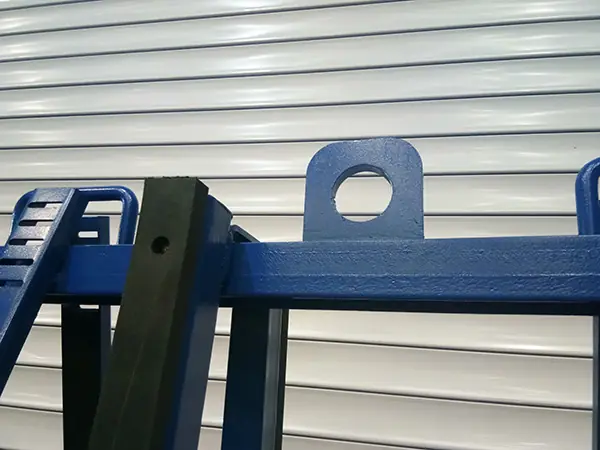
Customers often worry that a steel rack may damage glass or other fragile panels. That concern is valid, because poor contact design can turn a storage rack into a damage source. Mgrack addresses this by adding rubber protection to all key contact surfaces, including the bottom and side support positions where direct hard contact would otherwise happen.
For many buyers, this is not a cosmetic feature. It is part of the reason the rack can be used in real factory circulation. A protected support surface helps reduce scratches, chips, and vibration-related damage during internal transfer and temporary storage.
What Mgrack customers usually compare before buying
Most buyers do not compare Mgrack against nothing. They compare it against welded frames, simple wooden supports, or low-cost carts that look cheaper at the beginning. But the real comparison usually comes down to four questions: how safely the rack holds fragile panels, how easily it moves through the workshop, how much space it wastes during shipment, and how much labor it saves over time.
That is why Mgrack customers often make their final decision based on total use logic instead of headline price alone. When a rack supports better movement, safer panel restraint, and more efficient export packing, it changes the cost structure of the whole handling process rather than only the purchase order.
Frequently Asked Questions
Q: Is Mgrack only for glass sheets?
A: No. Mgrack is also used for stone slabs, solar panels, door and window components, and other fragile sheet materials depending on the required size and load.
Q: Why do customers care so much about the knock-down structure?
A: Because export and empty-return freight cost can become a major part of the total project cost. A knock-down design improves shipping density and helps reduce wasted volume.
Q: Can Mgrack be moved inside the factory without a forklift every time?
A: Yes. That is one of the core customer reasons for using it. With caster-based movement and protected contact areas, it supports internal workshop transfer more efficiently.
Q: Does Mgrack require assembly after arrival?
A: Yes. Customers should understand that this is a knock-down structure and on-site assembly is part of the logistics and cost-saving strategy.
Ready to upgrade your workflow?
Contact our engineering team today to discuss your specific requirements and get a customized solution.