
 EN
 DE
 RU
 FR
 PT
 ES
 IT
 JA

Warehouse glass storage layout
Grack’s single-sided L-frame lets you park along a wall, pair back-to-back in one lane, and keep the return trip compact. The layout improves forklift flow without forcing the glass team to change the basic handling method.
If your plant is fighting aisle congestion, the first question is not how many racks you can buy. It is how much usable floor you can recover from the racks you already need. That is where a single-sided L-frame glass storage rack behaves differently from a conventional A-frame: the geometry gives you a clear loaded face, a structural back plane, and a returnable rack that can be parked hard against a wall when the aisle needs to stay open.
Grack is built for that layout logic. It is not a fixed warehouse shelf and it is not one-way packaging. It is a reusable transport asset for flat glass that has to move between plant, truck, jobsite, warehouse, and back again. In a busy glazing shop, the point is to keep loaded glass stable, then make the empty racks shrink in volume when the job is done.
Why a single-sided L-frame can sit flush to a wall
The wall-side idea works because the rack is single-sided. The load lives on one side of the frame, so the other side does not need to remain open for picking or loading. The wall is only a boundary, not a support member. As long as forklift pockets, lifting points, and inspection access stay clear, the rack can be parked along the wall line and stop wasting aisle width.
That matters in glass plants where one side of the bay is already committed to traffic. If you leave the rack in the middle of the floor, the aisle has to work around it. If you move the same rack to the edge, the working lane becomes usable again. The result is not just a tidier floor; it is fewer conflicts between forklift travel, glass staging, and human walk paths.

How back-to-back placement changes density
Back-to-back placement is the second half of the same logic. Two single-sided Grack racks can be arranged rear-to-rear or run in a mirrored pair, so one lane supports two working faces instead of one. In simple layout terms, that can nearly double the active storage faces per lane run, while still keeping a clean forklift path in front of the working side.
Compared with an A-frame, this is where the trade-off becomes clear. An A-frame is stable and familiar, but when it is empty it still occupies almost the same footprint. It does not compress the return volume in the same way. If your bottleneck is loaded stability only, an A-frame can still be acceptable. If your bottleneck is dead floor space, empty-rack return cost, or blocked aisles, the L-frame layout is usually the better lever.
The gain is real, but it is not magic. Actual floor savings depend on rack length, glass format, aisle width, turning radius, and fire or service clearance. So the right way to think about back-to-back placement is this: it increases working density without forcing a second lane, but only when your plant geometry actually supports it.
What happens after unloading matters just as much
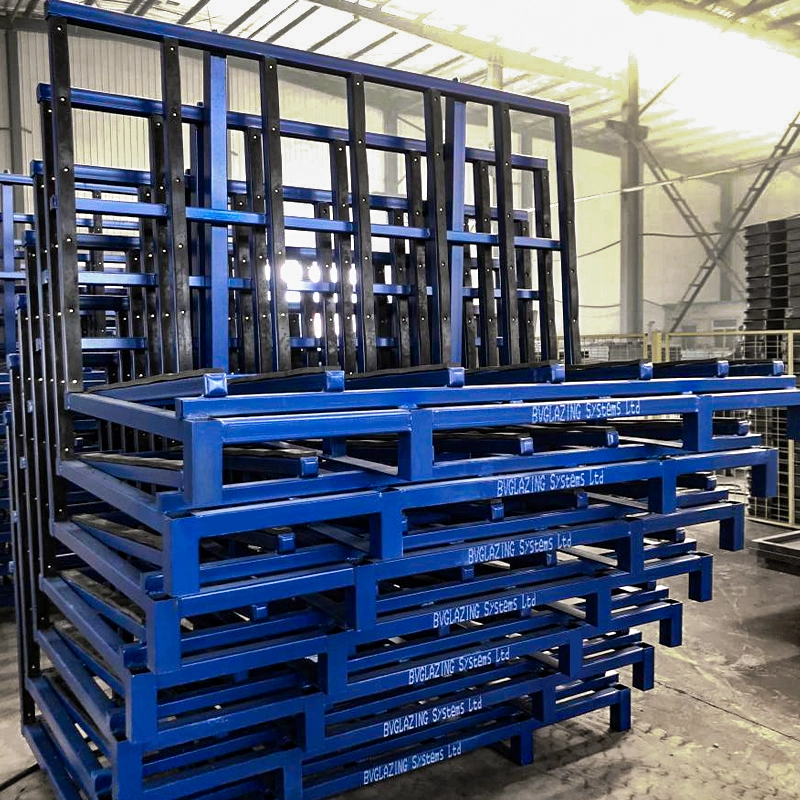
The hidden advantage of Grack is not only where the loaded rack sits. It is what the empty rack does next. Empty L-frame racks can nest or invert-stack, so the return volume drops sharply instead of traveling home as a full-size shell. That makes a difference in truck returns, export recovery, and line-end staging, because the rack no longer consumes the same amount of floor or freight space after the glass has left.
The image below shows the return logic in practice. The empty racks do not sit like a permanent obstacle. They compact into a tighter stack, which is exactly what an A-frame usually does not do well. If your operation sends racks back by truck or container, this is where the layout choice pays back again.
What to verify before you lock the layout
- Measure the real aisle you want to recover. Grack supports wall-side placement, but you still need enough room for forklift forks, turns, and safe pedestrian access.
- Decide whether the rack will live on a wall run or in a back-to-back pair. The layout works best when the glass size, load direction, and access side stay consistent.
- Check the protection method, not just the frame. Grack uses steel-core rubber strips fixed mechanically with screws, which avoids the pad-peeling problem that glued liners can create under load and vibration.
- Plan the return trip before you buy. If empty racks go back frequently, nesting is a major advantage. If return volume does not matter, an A-frame may still be workable, but it will not compress the same way.