
 EN
 DE
 RU
 FR
 PT
 ES
 IT
 JA
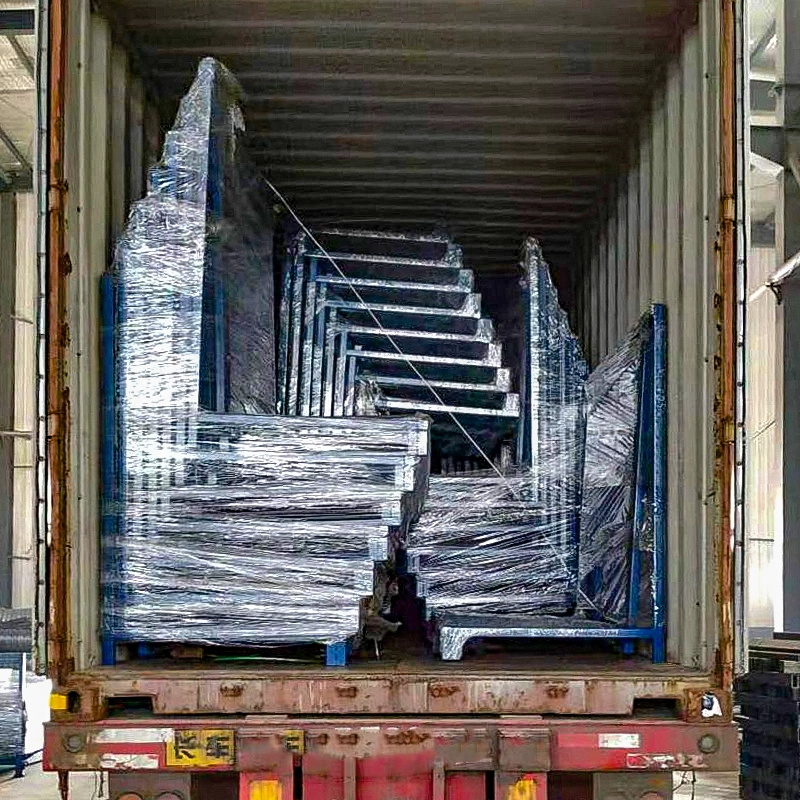
Most glass racks get judged while they are full. That is the easy part. The real bill shows up on the back haul, when a yard is packed with empty steel frames and a truck is paying to move air.
Grack was built for that second trip. It is a returnable transport rack, not a dead-end storage stand. It nests, it protects the edge with steel-core rubber, and it relies on a full seam welded Q235 frame that can survive real plant work instead of brochure handling.
It is also empty-return freight, yard clutter, and the kind of delay that starts when a rack can only be handled one way.
Empty return is where the real math starts
With Grack, empty racks do not travel like loose dead weight. The nested geometry lets the fleet pack down hard, and the export layout reaches 98 units in a 40HQ container. That number is the point. Once the rack family can collapse into a tight stack, you stop paying to ship the same steel space again and again.
That changes how the route works. A rack stops behaving like a one-way expense and starts behaving like a reusable asset. On busy export lanes, that shift changes how often the yard gets cleared, how many trucks are needed, and how much room the fleet steals while it is waiting to go home.
Engineering truth: a returnable transport rack only earns its keep when the empty leg is short, dense, and predictable. Nesting is not a nice extra. It is the reason the frame exists.

Steel-core rubber is the part that keeps the glass out of trouble
Glass edges do not need much help to become a problem. A weak pad gets cut, a glued strip peels, and the load ends up touching raw steel. That is where chips, edge crush, and ugly claims start. Grack avoids that by using a steel-core rubber strip that is mechanically fixed, not glued on and hoped for.
The steel core spreads the pressure from the sharp edge, while the screws hold the strip in place through heat, moisture, vibration, and repeated use. The loading angle stays in the safe 85-87 degree range, so the sheet leans back into the frame instead of wandering forward.
What buyers usually miss: if the pad can be cut, the rack is not protecting anything. It is just delaying the damage.
Why full seam welds matter when the rack gets hit, lifted, and re-stacked
Grack is built from Q235 carbon steel, with common main tubes in the 50×50 mm and 60×60 mm range and bottom channels that can run to 100×50 mm for fork handling. That matters because the base takes the abuse. Forks do not politely touch the frame. They push, scrape, and lift from bad angles.
Full seam welding gives the rack a single structural path instead of a chain of weak points. The top lifting pins, four-way fork entry, and load-bearing base all work together. That is why the rack family can cover heavy duty use across glass, slab, and panel routes without turning into a repair project.

Where Grack fits in a plant
The best use case is a closed loop. Glass leaves the line, rides on the rack, reaches the job site or distributor, then comes back for the next round. That is why this frame family shows up in glazing plants, window and door shops, curtain wall yards, and stone workshops. It is a steel glass pallet for routes that actually return.
It is also why Grack is not a good fit for every situation. If the rack never comes back, the nesting value disappears. If the operation expects hand pushing instead of fork trucks or cranes, the rack family is the wrong tool. The frame is built for mechanical handling and repeat cycles, not for pretending to be a lightweight cart.
Frequently Asked Questions
Q: How many Grack units fit in a 40HQ?
A: The standard export layout reaches 98 nested units in a 40HQ container.
Q: Will the rubber strip peel off after repeated use?
A: No. It is mechanically fastened with screws and backed by a steel core, so it does not rely on glue.
Q: Can the rack be moved by forklift and crane?
A: Yes. The family uses four-way fork entry and top lifting pins, so it can move in both shop-floor and site conditions.
Send your rack count for a nesting check
If you want to know whether Grack makes sense on your route, send the sheet size, the target container, and the number of empty racks that come home. We will size the frame around the real loop, not a catalog guess.