
 EN
 DE
 RU
 FR
 PT
 ES
 IT
 JA

CVLift Pneumatic Vacuum Lifter
A pneumatic glass flipping machine that handles horizontal-to-vertical changeover at the workstation, replacing the multi-person manual lift that slows down cutting, tempering, laminating, and racking stations.
Inside most glass plants the real bottleneck is not the cutting table or the tempering furnace. It is the transfer between stations. Operators pick up a freshly cut lite, walk it to the next machine, and then ask two or three people to stand the sheet upright, lay it flat again, or rotate it for the next operation. That horizontal-to-vertical changeover repeats at every cell: cutting to tempering, tempering to laminating, laminating to inspection, inspection to the rack. The minute a crew of two or three is busy flipping a panel, the upstream machine is idle and the downstream machine is starving.
A glass flipping machine built into the workstation shortens that changeover to seconds and keeps each operator working alone. CVLift is a pneumatic vacuum glass lifter from GSR Glass Solutions that performs a 90 degree turnover and a 360 degree rotation on the same frame. It connects to the factory air line, requires no battery charging, and slots into an existing cell without rearranging the line.
Where Horizontal-to-Vertical Changeover Drains Throughput
Most flat glass plants run a repeating sequence: horizontal on the cutting bed, horizontal through washing, horizontal onto the tempering roller, then a flip for edge processing or IGU assembly, then back to horizontal for racking. LiSEC and other line builders flag this horizontal-versus-vertical handling as one of the most complex moves inside a glass plant, because the panel leaves the machine flat and must arrive at the next machine in a different orientation.
When that move is done by hand, three things break at once. First, labor cost. Two or three operators are tied up for each turnover, and the same crew is needed again on the next shift. Second, cycle time. Manual flipping takes 60 to 120 seconds per panel, and the upstream station waits while it happens. Third, yield. Every manual grip is a chance for a finger mark, an edge chip, or a cracked lite, and silica gel or rubber pads alone cannot protect a sheet that is being wrestled by hand.
A glass flipping machine installed at the workstation removes the crew, removes the wait, and removes the manual grip. The operator loads the panel onto the suction frame, presses the button, and the machine performs the 90 degree turnover. The upstream machine can keep cycling.

Why a Pneumatic Vacuum Lifter Fits the Production Cell
CVLift is designed for fixed workstations with a stable compressed air supply. The vacuum system is driven by the factory compressor through a hose, so there is no battery to charge between shifts and no charger to schedule. As long as the air line is live, the lifter is ready. That matches the rhythm of an IGU line, a laminating line, or a tempering line, where the same workstation runs the same handover hundreds of times per day.
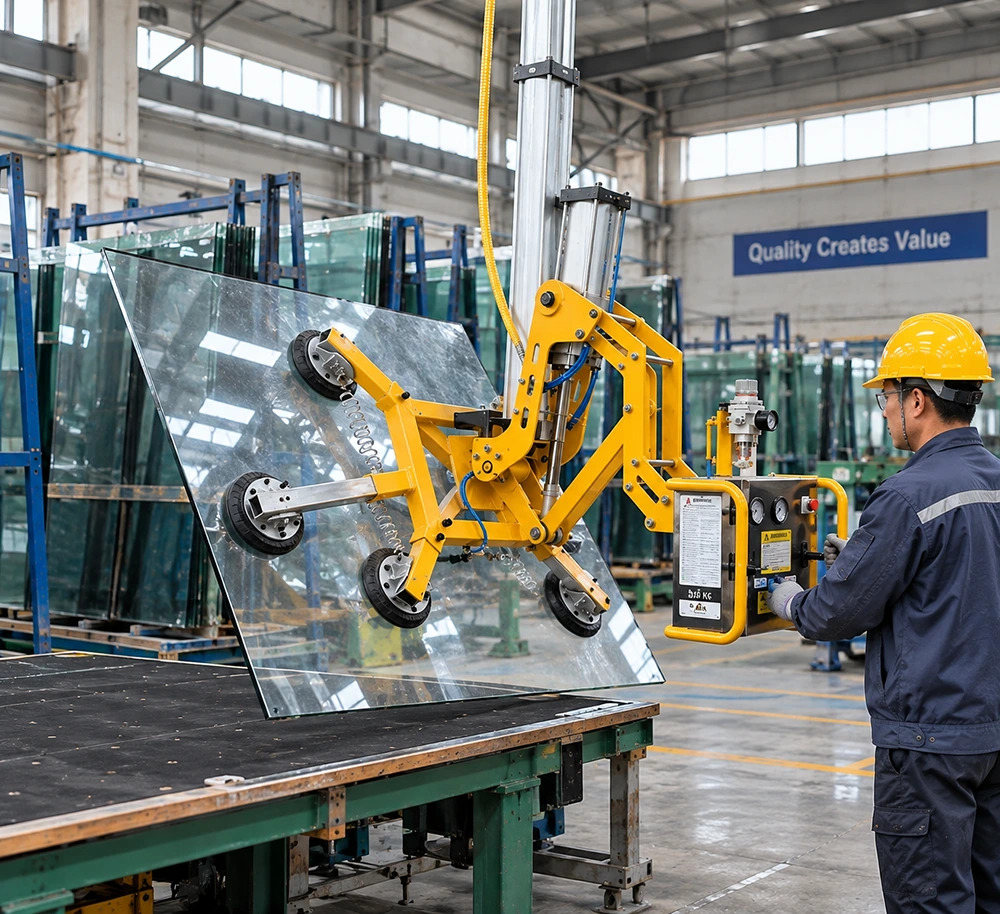
The frame carries multiple adjustment holes on the steel tube, so the suction pad position can be moved up for large panels and down for smaller cut sizes. The pads are 250 mm silica gel cups on the TR-FZ350-4 configuration shown on the GSR product page, with a working load of 250 kg, a 1.2 m vertical lift, and a 90 degree rotation controlled from the panel. Silica gel leaves no mark on coated or mirrored glass and tolerates the temperature range common in laminating and pre-process cells.
For plants that already run an overhead compressor and a ring main, this is the lowest-friction way to add a glass flipping machine to an existing cell. No new power circuit, no charging bay, no battery stockroom.
Built-In 90 Degree Turnover and 360 Degree Rotation
The two motions that matter for inter-station transfer are already on the machine. A 90 degree turnover pivots the panel between horizontal and vertical, which is the move that normally needs two or three operators. A 360 degree rotation inside the suction frame aligns the panel with the next station without the operator walking around the load.
In practice the sequence looks like this. The operator lays the panel on the suction frame, presses the button to engage vacuum, then triggers the turnover. The frame tilts to vertical, rotates to face the next station, and lowers onto the receiving table or rack. The same operator releases the vacuum and walks back. No second person is needed to steady the panel, no third person is needed to flip it.
This is the core difference between a glass flipping machine that lives in the cell and a generic vacuum lifter that only lifts. CVLift combines the turnover and the rotation on one frame, so the panel leaves one machine oriented correctly for the next machine. Stations that used to need a buffer zone for manual flipping can be pulled closer together.
How CVLift Slots into Cutting, Tempering, Laminating, and Racking Cells
Cutting to tempering: cut lites come off the bed horizontal and must enter the tempering furnace in the same orientation, but downstream washers and inspection tables often want the panel vertical. CVLift performs that turnover at the transfer point, so the cutting table feeds the washer without stopping.
Tempering to laminating: tempered glass arrives hot and horizontal. The laminating line needs it vertical for film layup and pre-press. The 90 degree turnover happens at a single workstation instead of a manual station that pulls operators off other jobs.
Laminating to inspection and racking: finished laminated panels need to be rotated to the inspection angle, then set onto an A-frame rack. The 360 degree rotation aligns the panel with the inspector, and the lifter lowers it onto the rack without a second crew.
Across these cells the machine is doing the same thing: replacing the manual horizontal-to-vertical handover with one button press. Plants that map their cycle time usually find that the handover, not the machine cycle, is where minutes are lost.
What to Confirm Before Specifying the Machine
Before ordering, walk the cell with the GSR engineering team and verify four things.
Air supply. The workstation needs a stable compressed air line at the pressure the pneumatic system requires. A dedicated regulator and filter on the air line is standard for vacuum lifters.
Working load. The published working load for the TR-FZ350-4 configuration is 250 kg, based on the GSR product page. Subtitle references and image labels show other capacities for other configurations, so confirm the rated load for the exact frame and pad count being quoted.
Pad layout. The adjustment holes on the steel tube let you move the suction cups to match panel size. For very small cuts or very large sheets, the pad count and spacing may need to change.
Safety monitoring. Vacuum gauges and audible or visual alarms are standard on the pneumatic configuration shown on the GSR page. Confirm which alarms and pressure sensors are fitted on the specific build before signing off on the cell layout.
Pre-Order Checklist for a Glass Flipping Machine
- Confirm the workstation has a stable compressed air supply with a dedicated regulator and filter.
- Verify the rated working load for the exact frame and pad configuration being quoted (the TR-FZ350-4 page lists 250 kg; other configurations differ).
- Map the panel sizes handled at this cell and check the suction cup spacing against the smallest and largest cut.
- Confirm the 90 degree turnover and 360 degree rotation motions are present on the build being offered.
- Identify the receiving station orientation (horizontal table, vertical rack, inspection jig) so the rotation angle is correct on delivery.
- Confirm which pressure sensors, vacuum gauges, and audible or visual alarms are fitted on this build.
- Plan the operator workflow: one person loads, presses, and unloads without a second crew on standby.