
 EN
 DE
 RU
 FR
 PT
 ES
 IT
 JA


Are you tired of seeing your profit margin shrink with every scratched Low-E coating or chipped edge on a custom lite? If your shop floor is a chaotic maze of A-frames and carts creating bottlenecks between your CNC cutting table and tempering furnace, you’re not just losing space—you’re losing money on every job. It’s time to stop fighting your workflow and start optimizing it.
The Hidden Costs Bleeding Your Glass Fabrication Line
In the world of a Wholesale Glass Fabricator or a custom IGU manufacturer, the term “good enough” is dangerous. The old A-frames and generic carts scattered around your facility might seem like a sunk cost, but they are actively draining your profitability through inefficiencies and material loss that are often hard to track until it’s too late.
Pain Point #1: The Scrap Pile from Micro-Cracks and Chipped Edges
Consider the journey of a 6mm glass lite. On a traditional rack with wide, hard rollers, that thin sheet rattles and vibrates with every move from the cutting line to the washer. These vibrations create invisible micro-cracks along the edges. The lite looks fine, but the damage is done. When it enters the Glass Tempering Furnace, the thermal stress turns that tiny flaw into a costly explosion or a rejected piece. This isn’t just a single lost lite; it’s wasted material, machine time, and labor, directly impacting your bottom line.
Pain Point #2: The “Non-Standard Size” Bottleneck
Your sales team just landed a lucrative architectural project requiring hundreds of tall, narrow glass panels. Your standard roller racks can’t support them; the short base of the glass only makes contact with one or two rollers, creating a severe tipping hazard. Production grinds to a halt as your team resorts to slow, risky manual handling. You’re forced to turn down or under-quote complex, high-margin jobs because your in-plant logistics can’t keep up. This operational inflexibility is a direct barrier to growth.
From Bottleneck to Buffer: How Harp Racks Engineer Profitability
A true solution isn’t just about storing glass; it’s about optimizing the entire flow of Work-in-Progress (WIP). A glass harp rack is engineered from the ground up to solve the specific physics and workflow challenges of a modern glass fabrication plant. The ROI is built directly into its design.
Structure for Protection: PVC-Coated Dividers
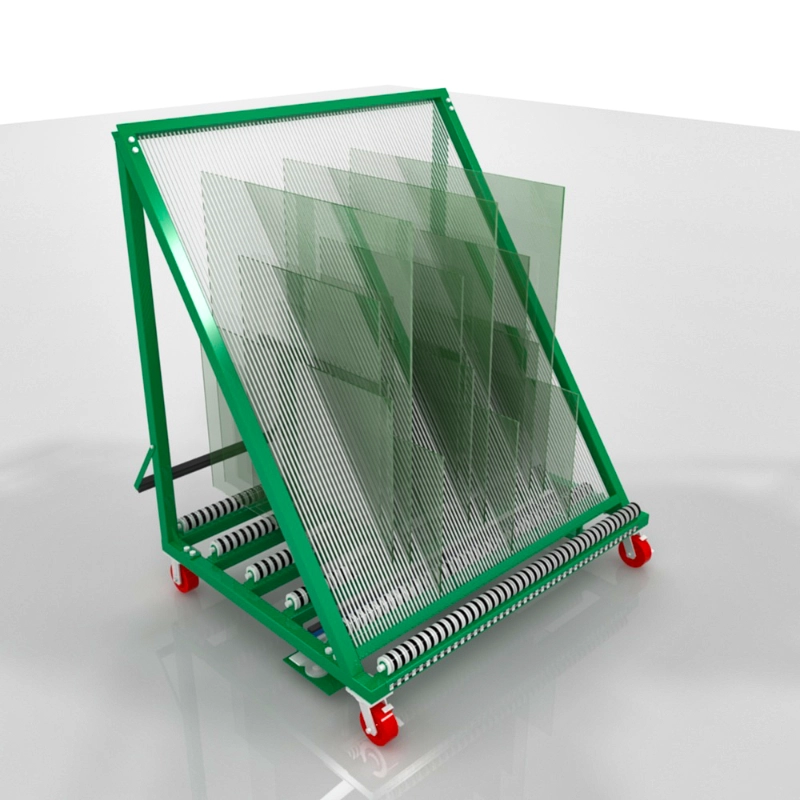
Unlike the hard, unforgiving contact points of other systems, each slot on a harp rack features a robust steel core coated in a soft, durable PVC casing. This design provides two key benefits: it creates a snug fit that eliminates the rattling responsible for micro-cracks, and it provides a non-abrasive surface that protects expensive coatings on materials like Low-E glass from scratches during loading and in-plant transfer. Each piece of glass is isolated and secure.
Structure for Flexibility: The Full Steel Base Advantage
To solve the challenge of non-standard lites, our full base harp racks replace rollers with a continuous, slotted steel base. This provides an unbroken line of support along the entire bottom edge of the glass, regardless of its length. Those tall, narrow architectural panels that were once a safety hazard are now perfectly stable. This single feature transforms your operational capability, allowing you to confidently take on any custom job without reconfiguring your entire shop floor.

Structure for Safety & Flow: Advanced Mobility
A harp rack is more than static storage; it’s a mobile WIP station. Equipped with heavy-duty polyurethane casters, it moves thousands of pounds of glass smoothly between processes. The critical innovation is the Foot-Actuated Lifting Mechanism. A simple press of the pedal lifts the entire rack slightly, disengaging the wheels and locking it firmly in place. This ensures absolute stability during loading and unloading, protecting both your product and your personnel from accidental movement.

Calculating Your Return: A Tangible ROI Analysis
Upgrading to high-density harp racks isn’t an expense; it’s an investment with a clear and rapid payback. Here’s how the numbers change:
| Metric | Before: Traditional Racks | After: High-Density Harp Racks | Tangible ROI |
|---|---|---|---|
| Material Scrap Rate | High rates from scratches, micro-cracks, and handling damage, especially on thin or coated glass. | Drastically reduced scrap due to isolated, protected surfaces and stable transport. | Lower material costs, higher profit per job, reduced waste disposal fees. |
| Floor Space Utilization | Large footprint A-frames and disorganized carts create cluttered, inefficient WIP areas. | High-density vertical storage frees up valuable square footage between machines. | Increased production capacity or room for new equipment without plant expansion. |
| Labor Efficiency | Slow, risky manual handling; difficult sorting for IGU “pairing” from large, mixed racks. | Fast, safe loading/unloading; streamlined sorting and kitting directly from the numbered slots. | Reduced labor hours per job, faster order fulfillment, and fewer workplace injuries. |
| Order Flexibility | Inability to efficiently or safely handle custom, non-standard glass sizes. | Confidently accept diverse, high-margin custom architectural and design jobs. | Increased revenue streams and a stronger competitive advantage in the market. |
Stop Managing Clutter, Start Driving Throughput
Your glass storage shouldn’t be an obstacle course. It should be an integrated part of a lean, efficient production line. By upgrading to a material handling system designed for the realities of glass fabrication, you’re making a direct investment in higher quality output, improved safety, and greater operational capacity. The ROI isn’t just on paper; you’ll see it on your shop floor and in your profit-and-loss statement.
Frequently Asked Questions
1. How does a harp rack handle very thin glass (e.g., under 1/4 inch) compared to an A-frame?
A harp rack excels here. We can customize the slot width of the base to provide a snug fit for thin glass, preventing the rattling and vibration that cause micro-cracks. On an A-frame, thin lites often lean against each other or a hard support, increasing the risk of damage during movement.
2. Can these racks be used to move glass directly from our CNC cutting table to the tempering furnace line?
Absolutely. That is their primary function. They are designed as mobile WIP (Work-in-Progress) buffer stations, allowing you to load cut lites, roll the entire rack to the next station like an edger or washer, and stage them for the furnace, streamlining the entire workflow.
3. What is the typical dynamic load capacity, and are they safe to move when fully loaded?
Our standard models, like the HR-40, have a dynamic load capacity of 1500 kg (approx. 3300 lbs). They are engineered with a low center of gravity and heavy-duty casters for safe, stable movement even when fully loaded. The foot-actuated locking mechanism provides an extra layer of safety when stationary.
4. We process a lot of custom shower doors with unique shapes. Is the ‘full base’ model better for this?
Yes, the full base harp racks model is the ideal solution. The continuous slotted base provides complete support along the bottom edge, regardless of the door’s width or cutouts. This eliminates the instability and risk of damage that can occur when non-rectangular shapes are placed on roller-based racks.
5. Our international shipping costs are a major concern. How does the knock-down design help?
Our racks feature a knock-down, bolted assembly structure. This means they can be shipped flat-packed, drastically reducing the shipping volume. This design is a significant advantage for container loading, allowing more units to fit in a single container and delivering substantial savings on freight costs for our international customers.
GET IN TOUCH
Please Don’t Hesitate If You Have Any Questions Or Special Requirements Fill In The Form Below!
Request a Factory-Direct Price Quote
Get customized CAD drawings, dynamic loading calculations, and wholesale price quotes. Response within 12 hours.