
 EN
 DE
 RU
 FR
 PT
 ES
 IT
 JA


In your fabrication shop, a single slip or a moment of instability between the CNC cutting table and the tempering furnace doesn’t just mean a loud crash. It means scrapped Low-E glass, production delays, and risks to your team. A harp rack for glass is your mobile WIP station, but its true value lies in eliminating these daily, costly risks. Let’s ensure every transfer is a safe one.
In the high-stakes environment of a glass fabrication facility, safety is inextricably linked to profitability. Moving large, heavy, and fragile glass lites between processes—from the cutting line to washing, tempering, or IGU assembly—is a critical control point. The Harp Rack is designed to be the backbone of this internal logistics chain, but unlocking its full potential requires adhering to best practices. This guide provides a step-by-step approach to using your harp rack glass trolley safely, protecting both your team and your high-value materials.
Pre-Operation Checklist: Setting the Stage for Safety
Before the first piece of glass is loaded, a quick inspection ensures the equipment is ready for the demanding shop floor environment. A safe operation starts with a solid foundation.
Assembly and Structural Integrity
Our racks are shipped with a Knock-Down Bolted Assembly to reduce freight costs. Upon initial setup and during regular maintenance checks, it’s crucial to:
- Verify All Bolts: Ensure every bolt is securely tightened. A loose connection can compromise the frame’s integrity under a heavy load.
- Inspect Welds: Regularly check for any signs of stress or welding deformation. The full welding process on our Q235A Carbon Steel frames provides superior strength, but routine checks are essential for long-term safety.
Know Your Load Capacity
Every harp rack has a specified dynamic load capacity, typically around 1500 kg (approx. 3,300 lbs). Overloading is one of the most significant safety risks. Always adhere to the manufacturer’s limit to prevent structural failure or tipping during transit.
The Right Rack for the Right Glass
Safety isn’t just about weight; it’s about stability. Storing a tall, narrow piece of custom shower glass in a rack designed for large stock sheets is a recipe for disaster. For these applications, full base harp racks provide continuous bottom support, eliminating the tipping risk associated with standard roller designs. Similarly, when handling thin glass (e.g., 1/4″ or 6mm) for IGUs, a rack with custom-width slots prevents the lites from rattling, which can cause micro-cracks that lead to failure down the line.

A full steel base with slots provides complete support for non-standard or narrow glass lites, preventing instability.
Safe Loading Procedures: From Cutter to Rack
The loading process is where glass is most vulnerable to damage. Proper technique is key to preventing costly scratches, chips, and breakage.
Protecting High-Value Surfaces
Place the glass edge gently onto the Nylon rollers or the lead-in edge of the slotted base. Then, smoothly push the lite into an empty slot until it makes light contact with the rear rubber buffer strip. The PVC-Coated Steel Dividers are engineered to separate each lite, providing a soft, non-abrasive cushion that is critical for protecting sensitive Low-E coatings and preventing surface-to-surface contact.
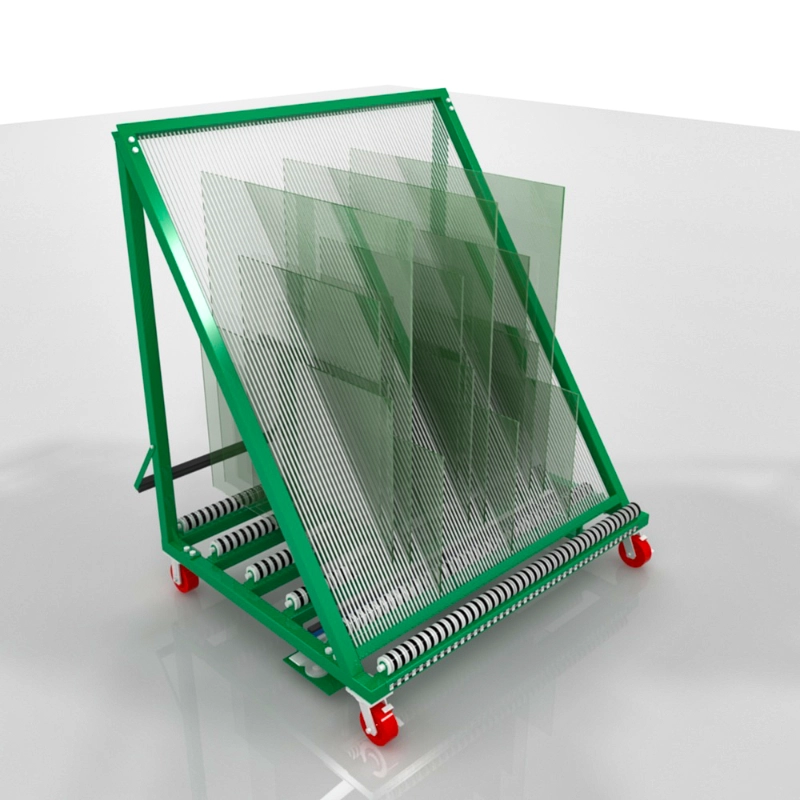
Each glass lite is isolated by a PVC-coated divider, eliminating the risk of scratches and contact damage.
Even Weight Distribution
When loading a rack, distribute the glass lites as evenly as possible across the base. Avoid loading all the weight on one side, as this can create an imbalance and make the rack difficult and unsafe to move.
The Critical Step: Safe In-Plant Transfer
Once loaded, the harp rack becomes a mobile unit. This is the stage with the highest potential for dynamic-related incidents. Following a strict protocol here is non-negotiable.
Engage the Locking Mechanism Before You Move
This is the single most important safety step. Before attempting to move the rack, you must engage the Foot-Actuated Lifting Mechanism. This device slightly lifts the entire load, taking the weight off the casters and locking the frame in place. It prevents the glass from shifting, sliding, or vibrating due to inertia or an uneven floor during transport. This mechanism is the ultimate safeguard against catastrophic load shifts.

The foot-actuated lifting mechanism is a crucial safety feature that locks the load before transport.
Navigating the Shop Floor
With the load securely locked, release the caster brakes. Use the handles to push the rack at a controlled, walking pace. Always ensure the path is clear of obstacles and personnel. For fully loaded or oversized racks, use the designated forklift entrance and a properly rated forklift for movement. The combination of two fixed and two braking swivel Heavy-duty Polyurethane Casters provides both maneuverability and stable parking.
Unloading and Staging for the Next Process
The final step is just as important. Safe unloading ensures the glass arrives at the next station—be it the washing machine or the IGU assembly line—in perfect condition.
Safe Unloading Practices
Once the rack is in position at the next workstation, engage the caster brakes. Only then should you disengage the foot-actuated lock. Remove glass lites one at a time, maintaining a firm grip. This controlled process prevents accidental damage and ensures operator safety.
The Harp Rack as a WIP Buffer for IGU Production
The harp rack excels as a tool for sorting glass units. The numbered slots allow operators to efficiently stage and “pair” the correct lites for Insulated Glass Unit (IGU) assembly. By organizing the components on a mobile rack, you create a streamlined, error-free workflow, moving an entire batch of paired lites to the assembly line at once. This not only speeds up production but also reduces handling, which in turn reduces the risk of damage and injury.

Numbered slots transform the harp rack into a high-efficiency sorting station for IGU pairing.
By integrating these safety protocols into your daily operations, you transform your harp rack from a simple storage device into a strategic asset that enhances workflow, minimizes material waste, and, most importantly, protects your team.
Frequently Asked Questions (FAQ)
1. What is the typical maximum load of a standard harp rack?
Most standard models, like our HR-40, have a dynamic load capacity of 1500 kg, which is approximately 3,300 pounds. It is critical to never exceed this limit to ensure structural and operational safety.
2. How do the PVC dividers protect sensitive surfaces like Low-E glass?
The dividers use a composite structure: a strong steel core for rigidity and a thick, soft PVC casing on the exterior. This PVC provides a non-abrasive, flexible contact surface that will not scratch or damage delicate coatings, unlike direct contact with metal or harder plastics.
3. Can I use a harp rack for very thin glass, like 1/4 inch (6mm)?
Absolutely. For thin glass, we highly recommend a model with a custom-width slotted base. Standard racks may have wider gaps, allowing thin lites to wobble and risk micro-fractures. A custom, narrower slot provides the necessary lateral support to hold thin glass securely during storage and transport.
4. What is the foot-actuated lock and why is it so important for safety?
It’s a mechanical lever system operated by foot. When engaged, it lifts the rack’s frame slightly, taking the load off the wheels and creating a fixed, stable base. This is crucial because it prevents the entire load of heavy glass from shifting or sliding due to momentum when you start, stop, or turn, which is a leading cause of transport accidents.
5. How does a harp rack specifically help with Insulated Glass Unit (IGU) production?
Its primary benefit is in sorting and pairing. In IGU manufacturing, you need to match specific lites (e.g., Lite 1 and Lite 2) for an assembly. The harp rack’s multiple, often numbered, slots allow operators to organize these pairs perfectly. They can load an entire job’s worth of paired lites onto one mobile rack and move it directly to the IGU line, drastically improving efficiency and reducing handling errors.
GET IN TOUCH
Please Don’t Hesitate If You Have Any Questions Or Special Requirements Fill In The Form Below!
Request a Factory-Direct Price Quote
Get customized CAD drawings, dynamic loading calculations, and wholesale price quotes. Response within 12 hours.